
Meet at the airport (or at the first accommodation). Transfer from the airport to your accommodation.
Dinner at your own expense and overnight in a hotel, hostel or local home in Kiruna.
AccommodationHotel, hostel or local home
Choose which cookies you accept. Privacy policy
Audience measurement
Google Analytics and Matomo cookies — journeys, searches and bookings.
Targeted advertising
Google Ads, Meta and Effinity — conversions, personalised ads and campaign attribution.
Travel assistant
AI-generated answers. Check important information on our information pages, in your contract or with a human advisor at GrandAngle.Travel.
AI answers — when in doubt, ask an advisor.




The famous Kungsleden trail, or King’s Trail, is a Nordic classic. An authentic journey and an unforgettable ski expedition into the heart of Swedish Lapland!
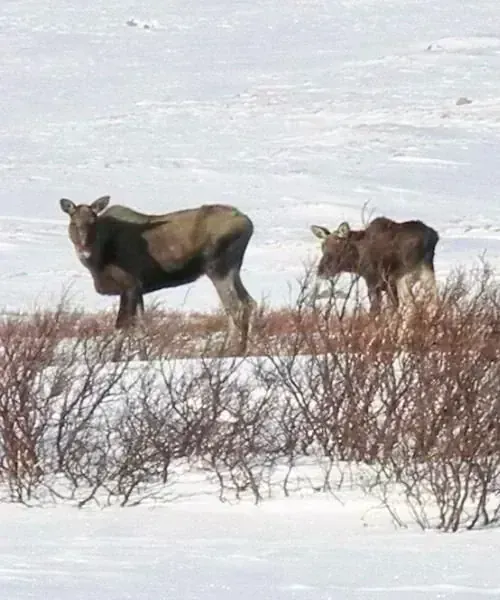
In the far north, not far from wild Sarek, one of Europe’s largest wilderness parks, the King’s Trail lives up to its name. This traverse of Swedish Lapland has a true sense of the Far North, heightened by the presence of Kebnekaise (2111m) and Sweden’s highest mountains. Long valleys wind between them, and we ski through these valleys, home to reindeer, ptarmigan and moose…
Here, you ski light: your luggage is transported each day by one of our Sami friends. A real luxury!
In the evenings, you enjoy Swedish mountain huts and share authentic, sociable experiences by the fire or in one of the many saunas.

Meet at the airport (or at the first accommodation). Transfer from the airport to your accommodation.
Dinner at your own expense and overnight in a hotel, hostel or local home in Kiruna.
Final preparations for the expedition and transfer to Abisko by taxi. Meet our Sami friend Pär Henrik, a reindeer herder, and his snowmobile, which will transport our luggage throughout the expedition.
Set off on the King’s Trail from Abisko to Abiskojaure hut (487m).
We leave Abisko beneath the famous gateway to the King’s Trail, climbing through sparse birch forest before continuing along Lake Abisko to the hut. Settle into the hut, comfortable for such a northerly location: well heated, with a well-equipped kitchen, sauna, chopped firewood, bunk beds with duvets, etc… All that remains is to fetch water from beneath the ice, prepare dinner and spend our first evening around a roaring wood fire. This is also moose and ptarmigan territory, and we may see them even close to the hut. Sauna available.
Dinner and overnight in a staffed mountain hut at Abiskojaure.
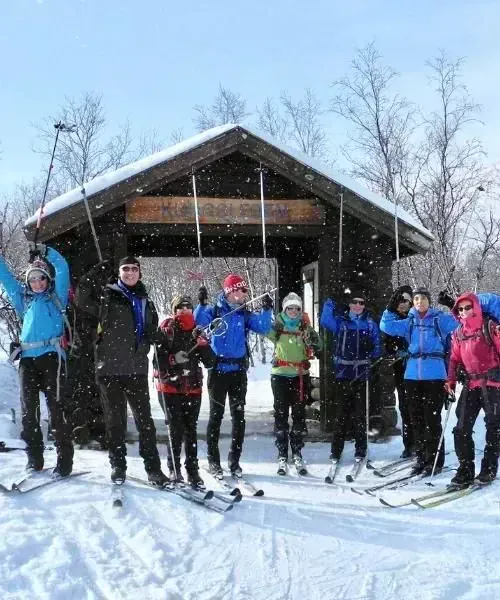
Following the Kamajakka valley through birch forest, we climb between Kieron (1543m) and Kartinvare (1154m), along a long valley that opens onto a fairly flat pass (830m). Before reaching the shores of the large Lake Alisjarvi, we can warm up if needed in the small but warm hut just before it. Alesjaure hut (780m), very close to a Sami village uninhabited in winter, comes into view at the end of the frozen lake, perched on a small hill. Settle in, with a sauna available.
Dinner and overnight in a staffed mountain hut at Alesjaure.
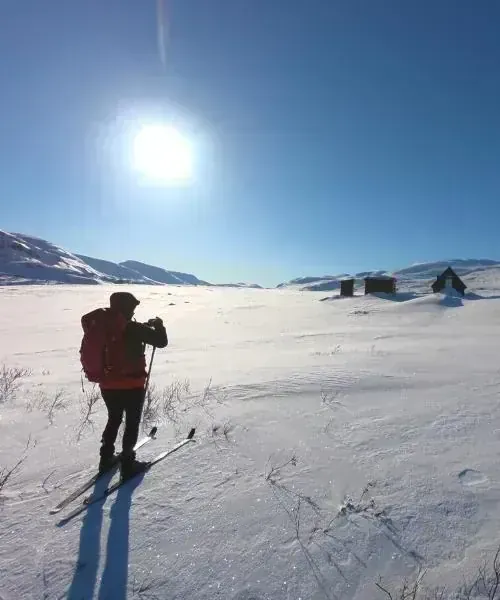
We leave Alesjaure for the broad Alesatno valley: a stage over easy terrain. We make a lovely ascent to Tjäktja mountain hut (930m), situated just below the pass of the same name at 1230m.
Dinner and overnight stay at the staffed mountain hut in Tjäktja.
From Tjäktja, there are 2 routes to choose from. Our favourite takes us via Nallo mountain hut, crossing a beautiful, remote pass away from the main route; we finish the stage in the magnificent Salka valley, where several valleys meet. A sauna is available at Sälkä.
Dinner and overnight stay at the staffed mountain hut in Sälkä.
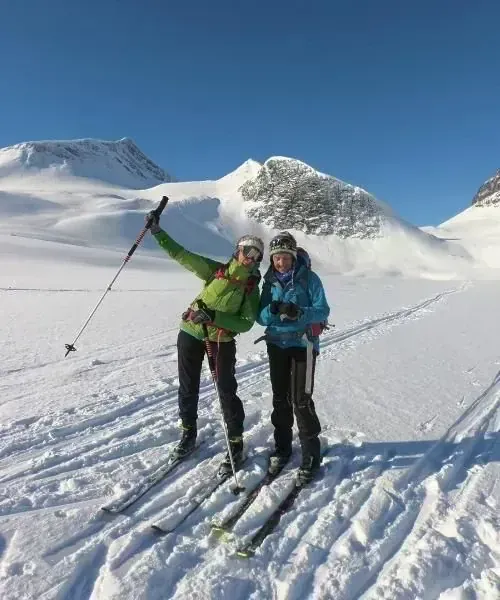
We set off through the superb, wild Cuhcavaggi valley, crossing an equally wild pass, then descend through the reindeer valley, with reindeer dotted throughout the landscape. An ascent of 2,5km takes us to a small pass, followed by a descent towards Kebnekaise mountain hut, heading due east through the broad Ladjojakka valley beneath Mount Kebnekaise, Sweden’s highest peak (2127m).
Dinner and overnight stay at the staffed mountain hut in Kebnekaise.
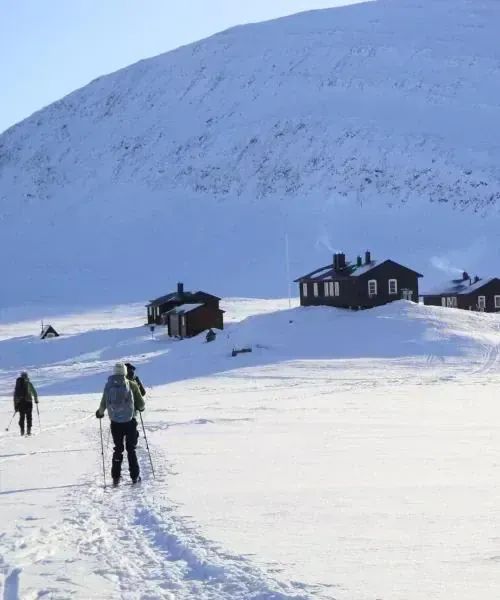
We continue through the broad, very open Laddjuvaggi valley, following the river lined with Arctic pines and birches, which we left behind on the first day in Abisko. Then the large lake of Laddjujarvi (5km) naturally leads us towards Nikkaluokta, at the end of this long but easy and beautiful stage. We collect our belongings in the Sámi village. After a final farewell to Pär Henrik, a reindeer herder, we depart by coach for Kiruna. Overnight stay in a homestay or hostel.
Dinner at your own expense and overnight stay in a hotel, hostel or homestay in Kiruna.
Transfer to the airport. The transfer is scheduled for the flight departing Kiruna at 10:40.
We may need to change the itinerary shown, either for operational reasons (accommodation capacity issues, splitting groups, changes in terrain conditions, rockfalls, damaged trails, etc.) or at the guide’s discretion (weather, the group’s ability, etc.). These changes are always made in your best interests, for your safety and greater comfort.
This trip is primarily intended for a French-speaking group, but you're welcome to join if you're comfortable in that environment.
The departure on 28/02 - 07/03/2027 is a departure WITHOUT luggage transfers
Kristiina Gaillard
Alps and Scandinavia travel expert
Thomas Praire
Technical Travel Manager
Intermediate to good skiing ability. Good stamina and physical fitness are required. The technical demands are not particularly high in good snow conditions, but it is best to be confident in all conditions, as the weather changes very quickly and conditions can become challenging at these latitudes. Daily stages involve 4 to 6/7 hours of skiing, with some elevation gain (up to +400m).
Version with luggage transport:
Luggage is carried by snowmobile (a bag weighing no more than 8 kg per person), usually driven by Pär Henrik, a Sámi reindeer herder. Please note: snowmobiles are only permitted for authorised users or specifically designated companies. The route therefore remains wild and very remote.
Your guide will provide you with a 30 L waterproof bag, which will be your transported luggage bag during the expedition.
Version without luggage transport:
No luggage transfers. You carry your belongings throughout the expedition. A pulka sled can be hired locally.
On the morning of day 2, we can leave our town clothes and other belongings at our accommodation in Kiruna; we will collect them on the evening of day 7 when we return from the expedition.
Transfers are by taxi between Kiruna Airport and the town centre, by train from Kiruna to Abisko, and by bus from Nikkaluokta to Kiruna.
If you wish, you can take a snowmobile taxi between the Kebnekaise mountain hut and Nikkaluokta (at your own expense, payable locally). This allows you to skip the 15–20km through the Laddjuvaggi valley. You can wait for the rest of the group in the warmth of the lovely building in Nikkaluokta, which is open to the public (food and souvenirs are available).
From 5 to 12 participants.
8 days, 7 nights, 6 days of skiing.
Departures are possible in February–March.
Guiding
A French Nordic skiing instructor with a state-recognised qualification.
Snow conditions
Snow cover at mid-altitude elevations can sometimes be unpredictable. This is first and foremost a trekking trip: if there is insufficient snow on some sections of the route, our trips will still go ahead. Remember to bring walking boots.
In a hostel or with local hosts in Kiruna, and in mountain huts along the King’s Trail. The huts along the King’s Trail all belong to STF (Svenska Turist Föreningen, the Swedish organisation that manages the huts) and are exemplary facilities in this very remote region.
With no running water (mainly because of freezing temperatures) or electricity, these mountain huts have dry toilets outside (you will need to take your down jacket!). Water is drawn from the nearby lake or river (the water is very pure), and wastewater is disposed of carefully. Firewood is always ready when you arrive, and the fire has almost always been kept going by the skiers before you. You will need to replenish the firewood supply before leaving to keep this system working; everyone leaves the hut as they found it on arrival. This system is unique in Europe: there is always a warden to manage skiers' arrivals, and some huts (Abiskojaure, Alesjaure and Salka) even have a small grocery shop. These huts provide duvets and a bed for everyone; the kitchens are very well equipped with gas and cooking utensils. The huts are divided into several units, which generally allows each group to have a cabin to themselves.
Some huts even have saunas (Days 2, 3 and 5). They are ideal for recovering and recharging after a day outdoors in the vast snowy landscape.
Restaurant meals in Kiruna on Days 1 and 7. The other meals are prepared together in the huts; everyone’s help is welcome! Some huts have small grocery shops selling everything you need for the trek.
Dinners on Days 1 and 7 are not included, but we will recommend a good restaurant where we can all have dinner together if you wish.
Please let us know about any food allergies when you book. We will do our best to adapt your meals.
Meeting point / End of the trip
On Day 1 at Kiruna Airport at 18:00 (or at the first accommodation).
On Day 8 at Kiruna Airport for the 10:40 flight (or at the final accommodation).
Around two weeks before departure, you will receive joining instructions specifying the meeting time and place, your electronic flight ticket, your guide’s name and contact details, and the address of your first accommodation.
Equipment hire
Ski hire: please contact us.
Flights are not included, but we can arrange them for you.
Since 2012, Grand Angle has been a member of ATR, the leading association for more responsible tourism. We design our trips – on foot, by bike and on snow – to invite everyone to discover the world differently: with curiosity, respect and kindness.
As members of the board of directors since 2018, we actively help the sector adopt more meaningful practices. In practical terms, we focus on:
We also share the values of the Traveller’s Ethical Charter, which encourages everyone to take simple steps to protect the places they travel through and make meaningful connections with the people they meet.
Since 2025, Grand Angle has held Travelife Partner status, an international label that certifies our responsible practices in environmental protection, ethics and sustainable management, both within our company and in our work with partners and the organisation of our trips.
This label, the second level of a rigorous international certification scheme, recognises our practical steps towards responsible tourism. We are actively working towards the next level, Travelife Certified, in line with our sustainable development policy
Choose wide, sturdy Nordic skis with metal edges, either waxable or with fishscale bases, metal poles and suitable boots. Synthetic climbing skins are provided on loan.
AVOID COTTON as it retains moisture and makes you cold!
A group first-aid kit is provided.
Our tip: If you enjoy wine, it is best to pack 1 bottle in your bag, as it is impossible to find locally (or prohibitively expensive)!!!
Sweden is in the European Union, but has not adopted the euro as its currency.
If you need Swedish kronor (SEK), check the current exchange rate before travel.
Before leaving for Sweden, it is best to obtain some local currency, as you will not really have an opportunity to exchange money once you arrive (things are always a little rushed at the airport, and you arrive late). Remember to order your currency from your bank well in advance! This makes things easier… but exchanging money at the airport on arrival is just as good value!
The Sámi (Lapps)
Sámi is the language spoken by the Sámi, a minority living in the northernmost part of Scandinavia. There are between 70000 and 100000 Sámi, but only a small proportion of them speak the language. Most Sámi speakers, numbering around 10000, are concentrated in northern Norway (the Finnmark region). There are approximately 17000 Sámi in Sweden, of whom around 7000 are proficient in the Sámi language. Most Sámi live in the northern towns of Kiruna (2,500), Gällivare (1,800), Jokkmokk (900) and Arvidsjaur (700). Around 1,000 Sámi live in and around Stockholm, but most of them do not speak the language.
Sámi is a Finno-Ugric language, closely related to the Baltic Finnic languages (such as Finnish and Estonian). According to a widely accepted theory, Sámi and the Baltic Finnic languages derive from a common ancestral language. Proto-Sámi is thought to have developed from this ancestral language around 1,000 BC and to have remained uniform until approximately 800 AD. It is then believed to have branched into different dialects.
There is no single Sámi identity, but rather a range of local identities connected to the local language variety and the territory where it is spoken. Other markers of identity include kinship and territory.
In economic terms, reindeer herding in certain areas, known as reindeer herding districts, is one of the group’s main activities. These districts are shared among the Sámi families to whom they traditionally belong. Residents must continue herding reindeer to remain part of such a district. There are roughly forty Sámi districts of this kind in Sweden. Nowadays, people are less inclined to do this type of work because it takes between 400 and 500 reindeer to establish a profitable herd. Hunting, fishing and handicrafts are the Sámi’s other traditional activities. Difficult economic conditions have led to substantial migration among Sámi communities. Two patterns of migration have been observed: on the one hand, Sámi have moved to small urban centres within their home region; on the other, there has also been (and continues to be) significant migration to coastal towns in the regions of Norrbotten and Västerbotten, and to the large metropolitan areas of southern Sweden.
The traditional Sami region (traditionally called Sami) covers a vast area stretching from the east coast of the Kola Peninsula, across the northernmost districts of Finland, through inland Sweden, and into the interior and along the coast of northern and central Norway.
The first contacts with Scandinavians were probably established more than a thousand years ago. However, it was not until the period of industrialisation, which began in the late nineteenth century and continued into the twentieth century, that Sami culture began to undergo major changes, mainly as a result of newcomers settling in Sápmi. This immigration gradually had a profound impact on the Sami people’s traditional way of life and settlement patterns. Today, for example, there are only a few municipalities in Norway where the Sami form a majority, such as Kautokeino and Karasjok. There is also one municipality with a Sami majority in Finland, Utsjoki. In Sweden, the largest Sami population lives in Kiruna, where they make up only 10% of the municipality’s total population. However, despite these apparently low population figures, the northernmost parts of Norway, Finland and Sweden form the heart of Sami territory. It is estimated that more than half of the Sami live in Norway (approximately 35,000), around 17,000 in Sweden, 6,000 in Finland and roughly 2,000 in Russia. These figures are of limited reliability, however, as there has never been a Sami census.
The fundamental principles of the Swedish Constitution state that: “Measures should be taken to promote opportunities for ethnic, linguistic and religious minorities to preserve and develop their own cultural and social life”. This has led to concrete results, namely the establishment of the Sami Parliament, Sami language teaching in schools and legislation concerning the Sami population. However, Sami is not considered an official language in the full sense of the term, and Sami speakers generally cannot communicate with public authorities in their own language.
A Sami parliament (Sametinget) with 31 elected members was established in 1991. Anyone who identifies as Sami or has parents or grandparents who speak or spoke Sami can register on the electoral roll. The Sami Parliament’s main responsibilities are as follows:
Members are elected by registered voters (who are still very few in number). Specific Sami parties take part in elections to the Sami Parliament (there are eleven different parties), but they do not play a significant role in local elections.
Sami literature has a rich oral tradition that is still alive today. Yoik songs, tales, epic narratives and legends form the roots of this tradition. As for written literature, Sami was first used in the 17th century. The first short story in Sami was published in 1912. In the early 80s, written Sami literature experienced a “breakthrough”, as a growing number of books began to be published, from poetry to novels. Although men were the pioneers of written literature, women now lead the way. Most Sami books are intended for children and young people.
The Sami language is used only in activities related to reindeer (hunting and herding), fishing and handicrafts.
Map at a scale of 1/100000
Fjallkartan, BD6, BD7, BD8
You can order these maps from L’Astrolabe in Paris, for example, from Le Vieux Campeur or from your favourite bookshop. They are also available locally in Sweden.
Would you like to make this a private trip?
Travel with friends or family on dates that suit you. Tell our specialists what you have in mind.

From €715
5 · 7 reviews

From €510
4,5 · 2 reviews

From €3,550
4,7 · 75 reviews

From €2,815
4,9 · 16 reviews

From €3,120
4,6 · 12 reviews

From €2,500
4,8 · 8 reviews
Your next adventure
Confirmed trips only
No trip matches — let us guide you Need help choosing?
Call us


