With your permission, we use cookies for detailed statistics and advertising. Without permission, Matomo measures audience without cookies; you can also disable it under Customize. Privacy policy
Listed as a UNESCO World Heritage Site since 1997, Dachstein and Salzkammergut form one of the most remarkable natural and cultural landscapes in the Austrian Alps. At 2995 metres, Dachstein’s rocky ridges rise above lush valleys, centuries-old glaciers and crystal-clear lakes that reflect the surrounding scenery. This region combines rare geological formations, karst landscapes, spruce forests and flower-filled alpine pastures with villages whose architecture and everyday life retain a remarkable authenticity.
At Grand Angle, drawing on our expertise in trekking in Austria, we offer you a fully immersive experience in this region. This 7-day guided trip invites you to explore the Austrian Alps on a point-to-point hiking holiday, away from the busiest trails. You will cross scenic mountain passes, stay in mountain huts and inns where the local food is hearty and delicious, and discover villages such as Hallstatt and Bad Ischl, which bear witness to the region’s history. You will also visit the famous salt mines, which are much more than a tourist attraction: they provide a living link between the geology of the massif and its historical development.
Grand Angle carefully selects every detail of your guided mountain holiday to focus on discovering the region at a comfortable pace and ensuring the group’s wellbeing. You will hike at a steady pace through landscapes where each day reveals a new side of Dachstein.
Hover or touch the profile to read the elevation. Keyboard: left and right arrows, Home and End. Escape clears the cursor.
Program
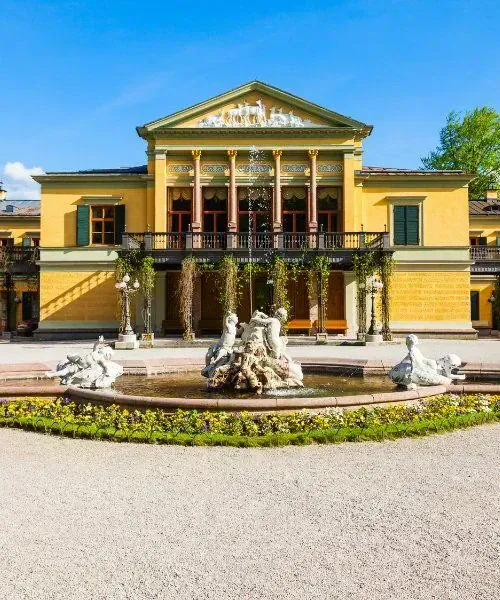
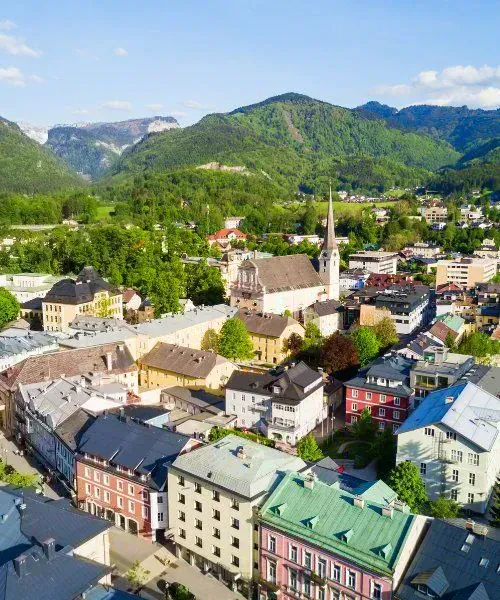
Welcome in Bad Ischl, a spa town and imperial city that was once the summer capital of the powerful Austro-Hungarian monarchy, in the heart of Salzkammergut. A short walk around the town, a visit to the gardens of the Imperial Villa www.kaiservilla.at and a transfer by local bus to Bad Goisern, a beautiful village with sturdy traditional houses on the banks of the River Traun, which flows into Lake Hallstatt. Dinner and overnight stay at a hotel - Gasthof in Bad Goisern.
Bad Ischl:
A little history: Excavations have confirmed that the site was inhabited as early as the La Tène period. Roman legions, drawn by the saltworks, fought to take control of the region, and a settlement was founded on the site of the present-day town of Bad Ischl. Under Roman rule, Bad Ischl, Salzburg and Hallstatt prospered through salt mining and trade. This prosperity ended with the Germanic invasions.
The spa town: Bad Ischl’s golden age began in 1823. The town quickly became one of Europe’s most important spa resorts. From 1849 to 1914, this glorious era reached its peak when Bad Ischl became the imperial summer residence of Emperor Franz Joseph.
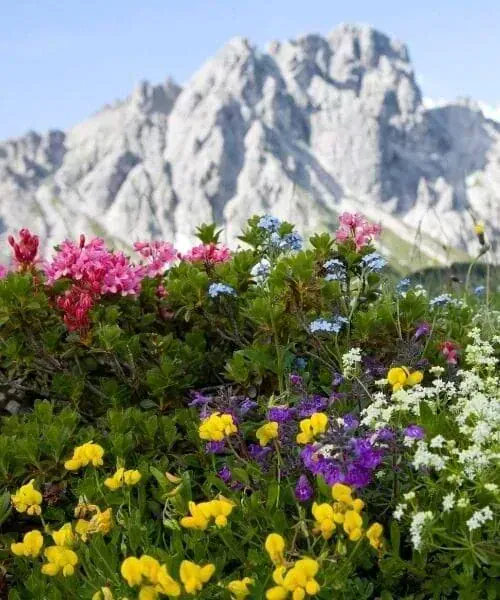
Today, a beautiful traverse will take us into the heart of the pastoral upper Gosau valley, home to a charming village set against the jagged ridges of the Gosaukamm range. From Bad Goisern, the trail climbs in steady zigzags through pine and larch trees to reach the ridge at the Goiserer Hütte mountain hut, at 1592m: here, amid carpets of gentians and houseleeks, the views over the Totes Gebirge and the Bad Goisern valley are outstanding. An optional ascent of Hoch Kalmberg (1833m, nicknamed “the Indian” because of its distinctive shape) offers a remarkable panorama of the Dachstein peaks. Allow an extra 1h15; those who choose not to climb to the summit can relax on the terrace of Goiserer Hütte while they wait. Beyond the hut, a vast area of alpine pastures opens up, including Schartenalm, bright with rhododendrons and dotted with alpine huts, each more charming than the last; the descent continues through forests and alpine pastures, with some beautiful views of the Gosaukamm range. Dinner and overnight stay at a hotel or Gasthof in Gosau.
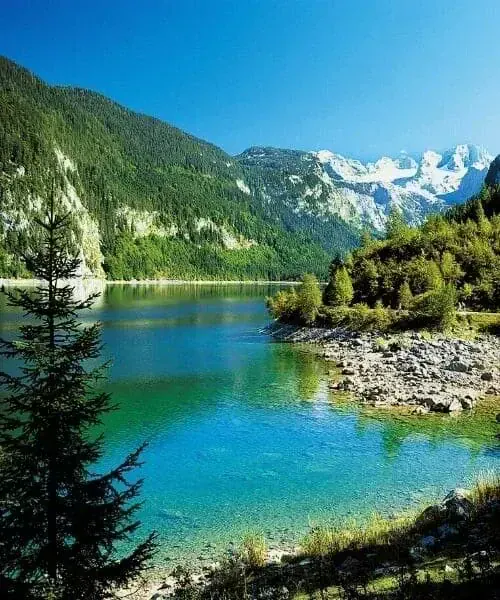
There are 3 lakes: the lower lake, Gosaulacke (this one is tiny!) and the upper lake, strung out along the narrow upper valley in which they nestle. These natural wonders reflect their surroundings, their colours changing with the time of day and the weather: blue-green, emerald green, dark green, steel grey… Around you, forests rise towards bare limestone cliffs, with the great glaciers of Hoher Dachstein beyond… This is the magnificent setting for a leisurely day! Return to Gosau. Dinner and overnight stay at a hotel or Gasthof in Gosau.
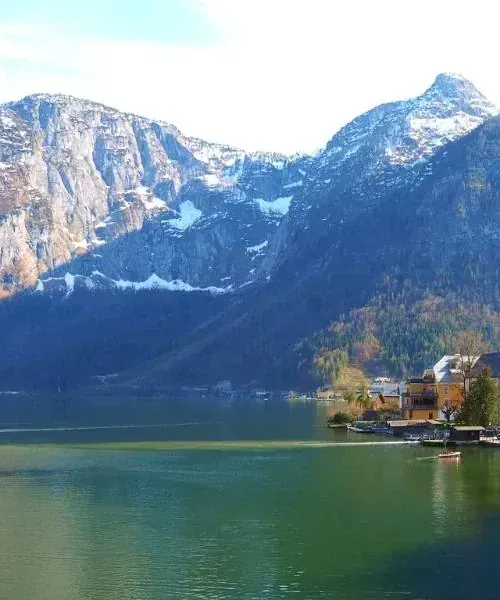
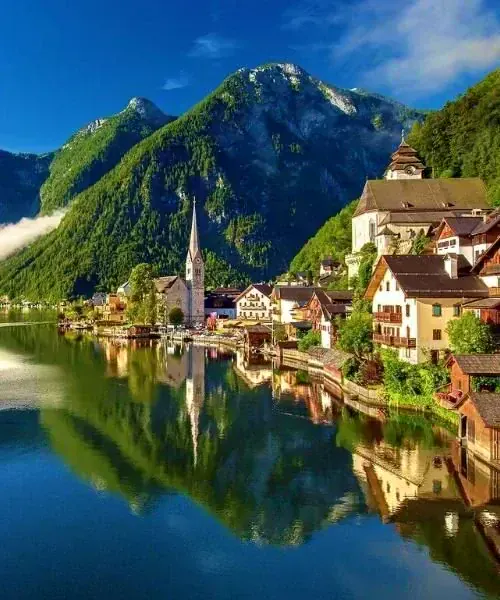
A day in the heart of a UNESCO World Heritage cultural site! After a short transfer to the shores of Lake Hallstatt, we follow the panoramic trail up Salzberg (the “salt mountain”) above Hallstatt. The views of the lake, village and surrounding peaks are simply magnificent. Visit the salt mine, the oldest in the world… worked since the Bronze Age! Descend to the village of Hallstatt, built right beside the lake’s calm, crystal-clear waters: the houses and mountains are reflected in it like an inverted photograph… Enjoy a short stroll through lanes lined with pastel-coloured houses adorned with flowers. We then take the cable car up to Krippenstein Lodge, at 2065m: an unforgettable evening, with magnificent panoramic views of the great Dachstein peaks. Dinner and overnight stay at Krippenstein Lodge (mountain hut and inn – www.lodge.at ), in shared rooms, occasionally in a small dormitory; settle in for 2 nights. We may need to replace Krippenstein Lodge with Gjaid Alm Hütte.
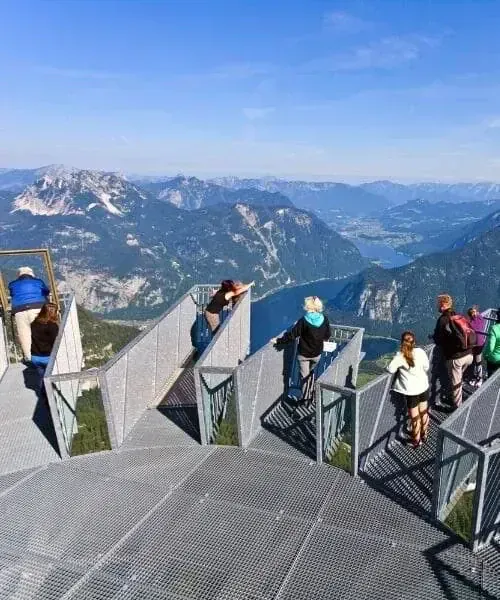
Walk to the spectacular “5 Fingers” viewpoint (2034m). This viewing platform, built on Krippenstein mountain and extending like 5 fingers over the void, offers outstanding panoramic views of Lake Hallstatt, the valley and the entire Salzkammergut region. An easy, mostly level walk leads to the Gjaid Alm mountain hut and inn: we are on the slopes of the Dachstein, with rugged terrain typical of karst landscapes. Panoramic views of the Dachstein’s peaks and glaciers. Dinner and overnight stay at Krippenstein Lodge (mountain hut and inn), in shared rooms, occasionally in a small dormitory. Dinner and overnight stay at Krippenstein Lodge We may need to replace Krippenstein Lodge with Gjaid Alm Hütte.
A magnificent stage along the Tragerweg, a trail winding through limestone pavements and flowers to the foot of the Hoher Dachstein glacier: we will get a close-up view of it from the Simonyhütte mountain hut, 2205m! Throughout the walk, the views of the glacier, the massif and the valley are breathtaking. We then descend to the Wiesberghaus mountain hut, 1872m, in a peaceful mountain setting with panoramic views. Dinner and overnight stay at the Wiesberghaus mountain hut.
We descend into the valley, leaving the distinctive terrain of the Dachstein behind to reach this World Heritage village in its dramatic setting, where people and nature exist in perfect harmony. We take time to explore and enjoy a beer on a lakeside terrace, then return to Bad Ischl by train in the early afternoon, bringing an unforgettable week to a close!
We may need to modify the itinerary shown, either for organisational reasons (overbooked accommodation, splitting groups, changes in ground conditions, rockfalls, damaged trails, etc.) or at the guide’s discretion (weather, the group’s ability, etc.). These changes are always made in your best interests, for your safety and greater comfort!
Dates, prices and booking
Booking dates are not currently available for this trip. Please check back soon or contact us to plan your journey.
Ask about upcoming departures
Your expenses during the trip
Kaiservilla park in Bad Ischl: approx. 6,5 €
Hallstatt salt mines: approx. 28 € (approx. 40 € if the group decides to take the cog railway up)
Price includes
accommodation from Day 1 to Day 7
guide services
meals from dinner on Day 1 to lunch on Day 7
luggage transport as specified
local transfers: bus / train from Bad Ischl to Bad Goisern + from Gosau to Hallstatt + from Hallstatt to Obertraun + from Hallstatt to Bad Ischl
the cable car to Krippenstein and the 5 Fingers viewing platform
Price excludes
drinks
site visits
any additional transfers
insurance
booking fees
Optional guide gratuities.
anything not listed under “Prices include”
Options & supplements
Single room supplement for 3 nights (Day 1 + Day 2 + Day 3): + 195 €
Your travel advisors
Kristiina Gaillard
Travel Advisor
Write
Thomas Praire
Technical Travel Manager
Write
Technical and practical information
For walkers with a moderate to good level of fitness. 4 to 6 of walking per day; maximum ascent: +980m (Day 3). Although most days involve moderate elevation gains, experienced walkers will also find plenty to enjoy: the mountain scenery is magnificent, with a real alpine atmosphere.
Your luggage is transported every day. You only carry a small backpack with your belongings for the day and your picnic lunch.
In hotels and Gasthof inns, in 2 rooms with private shower and toilet (3 nights); occasionally in a room for 3 if there is an odd number of male or female solo travellers.
A few more details:
For rooms for 2, the distinction between a double (one large bed for 2) and a twin (2 separate beds) is rarely as clear-cut as elsewhere: beds usually consist of two 90 cm mattresses placed side by side, each with its own sheets and duvet.
Hotel or Gasthof? There is little difference, and it is not a matter of comfort; a Gasthof is generally family-run and smaller than a hotel.
In mountain huts and inns: 3 nights in rooms sleeping 2 to 5, occasionally in a small dormitory.
These mountain huts and inns are particularly well located and well equipped.
Half board, with dinner and breakfast at the hotel or mountain hut; picnic lunch at midday; snacks for the walks
Meeting point / End of the trip
Meeting point
On Day 1, at 14:00 at Bad Ischl railway station
End of the trip
On Day 7, at around 15:00 at Bad Ischl railway station.
7 days, 6 nights.
Guiding
A French mountain walking guide with a state-recognised qualification.
6 to 14 people
Occasionally, the group may include one extra person, for example if a couple books when only one place remains, or if bookings are made simultaneously.
Guide gratuities are optional and at your discretion. To reward outstanding service, a suggested guideline is 5–10% of the total trip cost. Local currency is preferred.
Flights are not included in the trip price, but we can book them for you. There are no scheduled direct flights from Paris. Scheduled flights with Austrian Airlines or Lufthansa, via Vienna or Frankfurt.
To search for a flight to Salzburg, visit Eurowings.
Salzburg Airport:
To Bad Ischl: journey time approximately 2, with a change in Salzburg
Vienna Airport:
To Bad Ischl: 4-hour journey, with a change at Attnang-Puchheim or Linz/Donau
From Hallstatt: journey time of 4 to 4½ hours, with a change at Attnang-Puchheim
Bad Ischl railway station. For information on timetables and tickets: SNCF: 0892353535 or www.voyagessncf.com / Austrian Federal Railways: www.oebb.at
Timetables to / from Paris: Outbound journey
The most convenient overnight train leaves Paris Est at 19:12 and arrives in Salzburg at 07:30. From Salzburg to Bad Ischl, the easiest connections are by bus (bus 150, from the bus terminal on Tiroler Platz in front of the main railway station): a direct journey of around 1 hour 30 minutes, departing every hour at 15 minutes past the hour. Alternatively, you can take the train (2 hours, 2 changes).
If you arrive in Salzburg early, we recommend leaving your luggage in a locker at the station and using your waiting time to explore Salzburg and its Baroque church towers before taking the bus to Bad Ischl. Ideally, of course, you would spend a full day in Salzburg.
Return journey
Saturday: expected arrival in Bad Ischl at around 15:00 (departure from Hallstatt at 14:32).
If you are returning to Salzburg the same day, you can travel directly from Hallstatt to Salzburg (changing at Attnang-Puchheim); allow 2 hours 15 minutes to 2 hours 40 minutes for the journey. There is an overnight train departing Salzburg at 22:18 and arriving at Paris Est at 10:24 the following morning. If you would like to take a daytime train, we recommend spending an extra night in Salzburg or Bad Ischl and leaving the following day.
Please note that all times are indicative and may still change. Please check the timetables.
For journey information, visit https://www.viamichelin.fr/. On your return, if you would like to spend a little longer strolling around Hallstatt, you can take a later direct train; it will take you from Hallstatt to Bad Ischl in 20–27 minutes, depending on the train. Trains run until 18:30.
You can leave your car in one of Bad Ischl’s 4 public car parks for the duration of your stay: Kurhausstraße, Rechensteg, Kaiservilla. Allow around 8€ per day.
There is also a 100-hour parking card costing 40 €. It allows you to park in the 3 public car parks.
Hours between 19:00 and 07:00 are counted at -50%. The card therefore lasts for a week.
It is available from the machines in the car parks or from Bad Ischl town hall (infostadtamt-badischl.atvasb@fgnqgnzg-onqvfpuy.ng) at the following address, from 08:00 to 12:00 and on Thursdays until 16:00:
Stadtamt Bad Ischl Pfarrgasse 11 4820 Bad Ischl +436132301-0
You can also park in the town centre, where there is an attended underground car park, or at the Salinenplatz car park, around 300m from the station; the daily rate is 5€.
Around two weeks before departure, you will receive a document specifying the meeting time and place, your guide’s name and contact details, and the address of your first accommodation.
Member of Agir pour un Tourisme Responsable (ATR)
Since 2012, Grand Angle has been a member of ATR, the leading association for more responsible tourism. We design our trips—on foot, by bike and on snow—to invite everyone to discover the world differently: with curiosity, respect and kindness.
As members of the board of directors since 2018, we actively help the sector develop more meaningful practices. In practical terms, we work to ensure:
Transparency in our practices and prices
Respect for our partners and local communities
Protection of the environment on every trip
We also share the values of the Traveller’s Ethical Charter, which encourages everyone to take simple steps to protect the places they visit and foster meaningful encounters.
Travelife Partner
Since 2025, Grand Angle has been recognised as a Travelife Partner, an international label that certifies our responsible environmental, ethical and sustainable management practices, both within our company and in our work with partners and the organisation of our trips.
This label, the second level of a rigorous international certification scheme, recognises our concrete actions in support of responsible tourism. We are actively working towards the next level, Travelife Certified, in line with our sustainable development policy
A Gore-Tex jacket (or rain poncho) + a fleece
A warm jumper or fleece
Shirts, T-shirts
2 pairs of walking trousers
2 pairs of shorts
A warm hat, a cap, a pair of gloves, 3 to 5 good pairs of socks
A pair of comfortable, high-cut hiking boots with good soles, supportive heel counters and reliable waterproofing is mandatory
A pair of outdoor shoes: for the evening, or possibly for walking if your hiking boots cause chafing (please note: these are no substitute for your hiking boots)
A comfortable backpack (40 to 50 litres)
A sleeping bag liner
A 1-litre water bottle, 1 knife, a torch or head torch (+ spare battery). A food container for your picnic
A good pair of sunglasses, sunscreen
Identification documents. An identity card is mandatory
A toiletry bag, a small first aid kit
Personal belongings: other clothing and a towel
A travel bag for the belongings that will be transported by taxi or cable car (10 kg maximum per person)
A mobile phone
50-litre bin bags to put your backpack contents in when it rains, keeping them dry
Personal belongings: other clothing and a towel
Country: Austria Capital: Vienna
The euro
Dialling code from France: 0043
Travellers, including children, must carry a national identity card or passport (EU nationals).
Bring your European Health Insurance Card, which you should request from your health insurance provider at least 15 days before departure. Health conditions are similar to those in France.
Austrian National Tourist Office 58, rue de Monceau 75068 PARIS or PO Box 475 – 75366 PARIS Cédex 08 Tel: 0153839520 - Fax: 0145619767 Email: oewparworldnet.frbrjcne@jbeyqarg.se Website: http://austria-tourism.at
There is no time difference
East: hot, dry summers and cold winters. Alpine regions: an alpine climate (high precipitation, short summers and cool evenings). The rest of the country: temperate and humid.
Information about Salzkammergut Dachstein, a UNESCO World Heritage Site
Human activity in the magnificent natural landscape of the Salzkammergut began in prehistoric times, with the exploitation of its salt deposits as early as the second millennium BC. This resource formed the basis of the region’s prosperity until the mid-20th century, a prosperity reflected in the beautiful architecture of the town of Hallstatt.
Outstanding Universal Value
Brief synthesis
The alpine landscape of Hallstatt-Dachstein, which forms part of the Salzkammergut and thus the Eastern Alps, is characterised by dramatic scenery, with immense mountains rising steeply from narrow valleys. Since medieval times, its prosperity has been based on salt extraction centred on the town of Hallstatt, whose name means “salt settlement”, a reminder of its original function.
Systematic salt production began in the region as early as the Middle Bronze Age (the late second millennium BC). Natural brine was collected in containers and evaporated. Salt mining began in the Late Bronze Age and resumed in the eighth century BC, as shown by archaeological evidence of a flourishing, highly organised and stratified Iron Age society with extensive trading links across Europe, now known as the “Hallstatt culture”. Salt extraction continued into Roman times and then resumed in the 14th century. The large quantities of timber needed to support the mine galleries and evaporate the brine came from the extensive forests of the mountain ranges, which had been controlled and managed directly by the Austrian crown since the 16th century. The town of Hallstatt was rebuilt in the late Baroque style after a fire in 1750 destroyed its wooden buildings.
The beauty of the alpine landscape—with its high-altitude pastures used for summer grazing by sheep and cattle since prehistoric times as part of the practice of transhumance, which still gives valley communities access rights to specific upland grazing areas—was “discovered” in the early 19th century by writers such as the novelist Adalbert Stifter, the poet and playwright Franz Grillparzer, and most of the leading painters of the Biedermeier school. As tourist numbers increased, hotels and brine spas were developed to accommodate visitors.
The landscape is exceptional, forming an area of great scientific interest and immense natural power that has played a fundamental role in human history, as shown by the marks left by miner-farmers over the centuries, while mining transformed the mountain’s interior and artists and writers described its harmony and beauty.
People have inhabited these valleys, dominated by high mountains, for more than three millennia. The extraction and processing of salt—a natural resource essential to human and animal life—gave this region its prosperity and distinctive character, closely linking a range of intensive human activities within a largely untamed landscape.
The alpine region of Hallstatt-Dachstein/Salzkammergut is an outstanding example of a natural landscape of great beauty and scientific interest that also preserves evidence of a fundamental human economic activity. The region’s cultural landscape has evolved continuously over 2500 years. From the outset, its history has been closely linked to the economic history of salt extraction. Salt mining has always shaped every aspect of life, as well as the architectural and artistic features that bear witness to it.
Integrity The property appropriately preserves all the elements associated with salt extraction and processing, the related production of timber, the seasonal movement of livestock between pastures, and dairy farming, and maintains the harmony that attracted artists and writers in the 19th century.
It has not suffered, and does not suffer, from the negative effects of modern development.
Authenticity As a result of its distinctive historical development, this cultural landscape has retained a degree of natural and social authenticity exceptional within the alpine region. It has preserved its spatial and physical structure, resulting from the interaction between people and the environment. This quality and setting have been further enhanced by the many artists who came to stay in the region; their numerous paintings and depictions provide further evidence of its value.
Transport
2.2 kg
Accommodation
38.3 kg
Meals
25.8 kg
Luggage
1.3 kg
Estimated carbon footprint per traveler, in kg CO₂ equivalent.
Reviews
4,4· 5 reviews
Arlette6/23/26
— Everything was great, except for the meals at the Alpenhotel, which were very, very mediocre.
Cécile7/31/26
— Great scenery, but maybe not challenging enough
•
—
— Reply from the team
Jacques7/31/26
— A lush, green setting with excellent, well-maintained trails; a "clean" region
Serge7/31/26
— A journey through nature and time back to our origins
•
—
— Reply from the team
Would you like to make this a private trip?
Travel with friends or family on dates that suit you. Tell our specialists what you have in mind.