The Cape Verde Archipelago from South to North

Next departure Nov 22, 2026
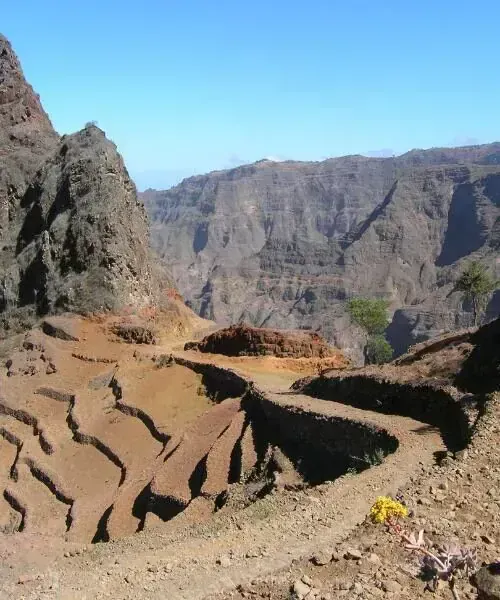
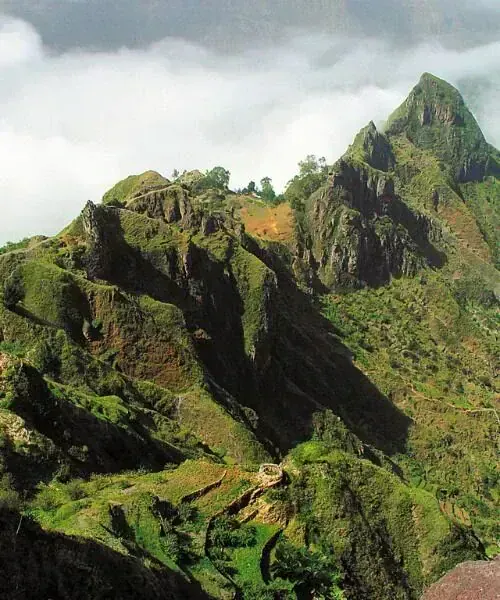
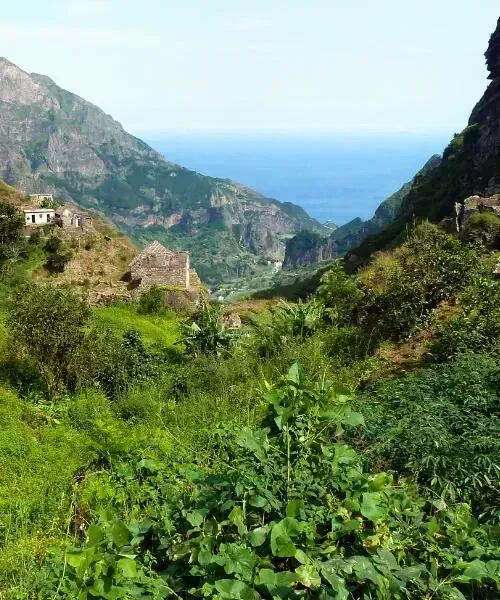
Ribeira da Torre valley - Santo Antão - Cape Verde
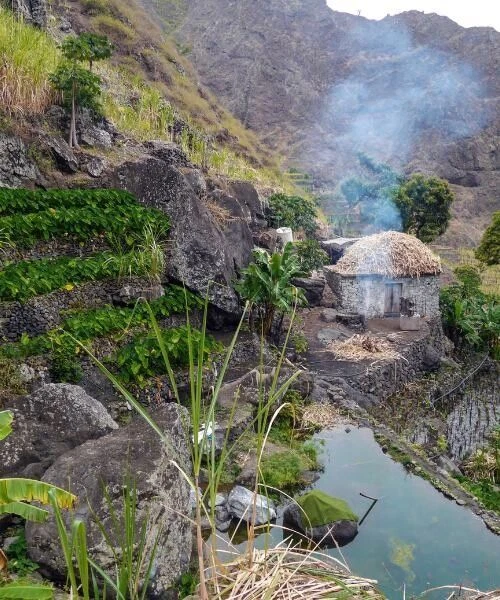
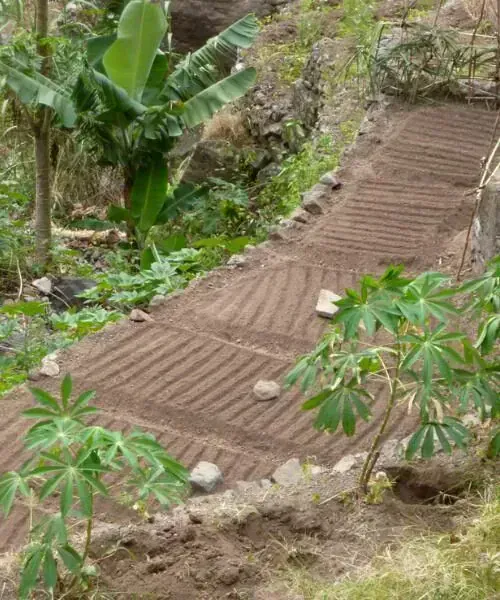
Terraced cultivated valley - Santo Antão - Cape Verde
Fogo - Cape Verde
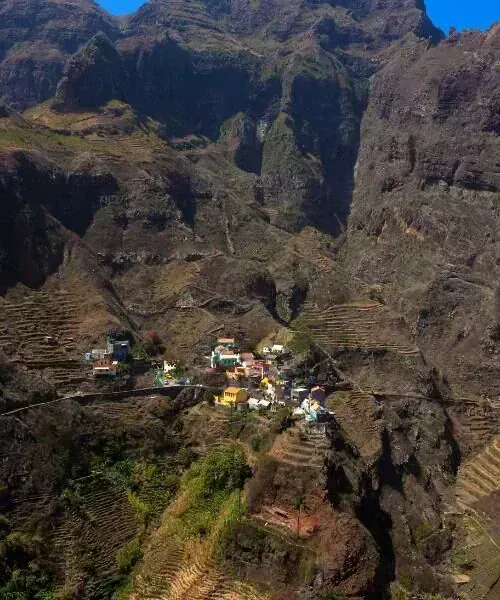
Fontainhas Cadobestock - Cape Verde
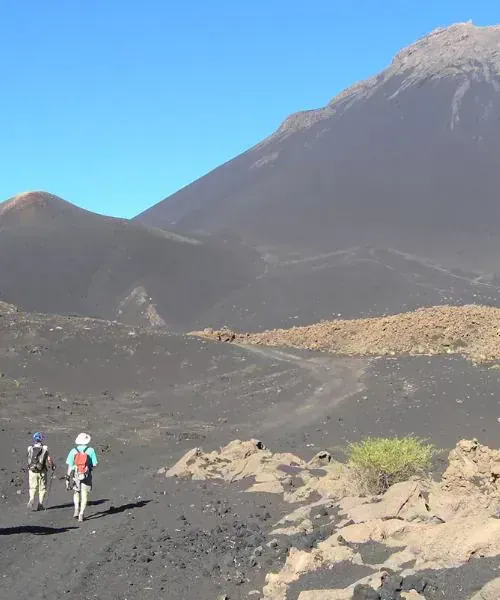
Hikers on a volcanic slope - Cape Verde
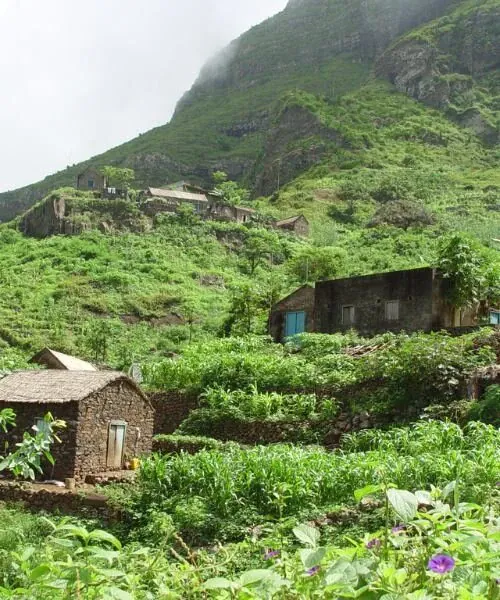
Lomba Tantum Brava Cap Vert Cmaei Boucard - Cape Verde
Colourful houses of Ribeira Grande - Santo Antão island - Cape Verde
Salazie Cirque - Reunion Island
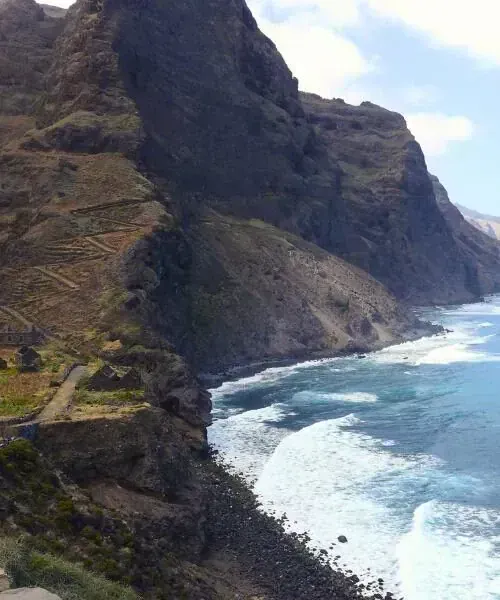
Terraced trail on a volcanic coast - Atlantic island
Tarrafal Santo Antao Cap Vert Ceric Balian - Cape Verde

Specialist in Cape Verde trekking, Grand Angle offers you a complete crossing of 15 days to discover the many facets of the archipelago. This hiking journey off the coast of Africa takes you from the volcanic lands of the south to the lush vegetation of the north, for a complete immersion off the continent African through five islands with well-defined characteristics.

The route progresses from Santiago, cultural cradle, to Fogo, dominated by its active volcano which you will approach, passing through the discreet Brava, the island of flowers. The journey continues northward, with a stop in São Vicente to feel the soul of Mindelo, before reaching the paradise of hikers: Santo Antão. You will walk its famous balcony trails, carved into the mountainside between terraced crops and basaltic peaks.

Offered as a group journey of human scale, this hiking itinerary of level 2 is led by a French-speaking local guide who will share their knowledge of the terrain with you. The alternation between high-altitude walks, coastal trails, and maritime crossings offers a contrasted and authentic experience in the heart of a lively and warm Cape Verde.

Program

Departure from Paris and flight* to Praia on the island of Santiago (flight via Sao Vicente or Lisbon). Welcome by your guide. Dinner on your own.

  • On certain dates, continuing flight to the island of Fogo with overnight in Sao Filipe.
    Overnight in a hotel in Praia.
AccommodationHotel

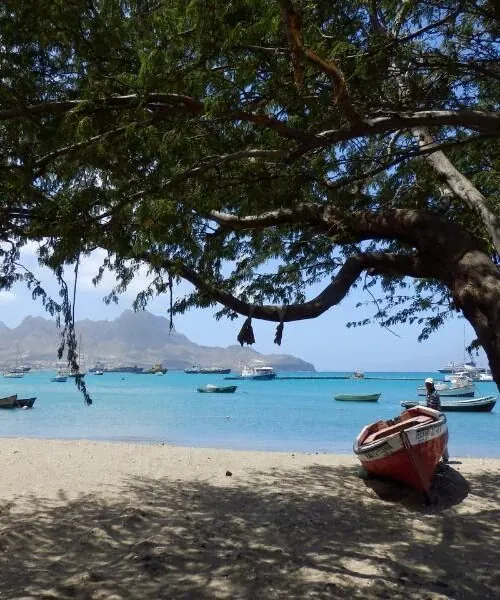
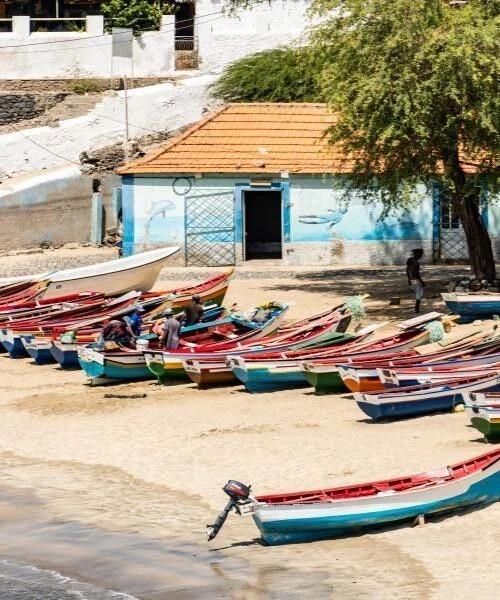
Morning flight to Fogo, lunch on your own. Drive to the Sao Lourenço mountain, stop to discover its ancient church and its baobab, the largest tree on the island. Continuation to Mira-Mira and hiking through the lovely panorama of hills dotted with small farms, with the Brava islets in the background. Then we continue to the small natural port of Salinas where a few colourful fishing boats are sheltered on the beach: the meeting between ocean and lava. Transfer to the port and ferry crossing to Brava* (30 minutes by boat). Settlement in Nova Sintra, a small jewel with magnificent colonial houses and flowering streets.

  • On certain dates, the ferry rotation is mid-day, thus removing the walk to Salinas, which will be replaced by a walk to Brava.
    Vehicle transfer: 30-60min.
    Overnight in a guesthouse in Nova Sintra.
AccommodationGuesthouse
D+Elevation gain: 250 m
D-Elevation loss: 400 m

From Nova Sintra, we set off to discover the plateau that dominates the island, its bocage with hibiscus hedges where cows graze, its view at 360° over the surrounding countryside and the slopes that descend to the ocean. From the Fontainhas crater we return to Nova Sintra.
Overnight in a guesthouse.

AccommodationGuesthouse
D+Elevation gain : 620 m
D-Elevation loss : 620 m

After crossing the hamlet of Nossa Senhora de Monte and its beautiful sobrados (Portuguese colonial architecture houses) we dive into the small fishing port of Faja d’Agua by crossing cultivation oases of sugar cane and mango trees.
Vehicle transfer: 30min.
Night at guesthouse in Nova Sintra.

AccommodationGuesthouse
D+Elevation gain : 200 m
D-Elevation loss : 850 m

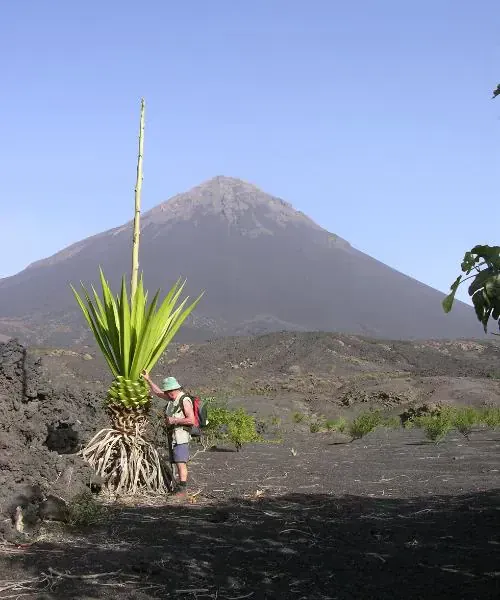
Morning boat to Fogo then transfer to the Chad as Caldeiras crater, at the entrance of the Natural Park. Hiking in the heart of this large 10 kilometre diameter caldera up to Pico Pequenho, site of the last eruption in November 2014 whose remains are still visible and spectacular. Continuation along recent lava flows to the old villages largely buried under lava, but whose inhabitants are undertaking reconstruction to continue living near their vineyard crops. Night in the heart of the crater at a local home in simple conditions (cold water and limited electricity).
Vehicle transfer: 2h
Night at guesthouse.

AccommodationGuesthouse
D+Elevation gain : 200 m
D-Elevation loss : 200 m

From the crater, superb ascent of Pico, the highest point of Cape Verde (2829mmetres) with magnificent panoramic views, and descent down the scoria slopes. Optional day with no technical difficulty.
Return and night at the crater.

AccommodationGuesthouse
D+Elevation gain : 1000 m
D-Elevation loss : 1000 m

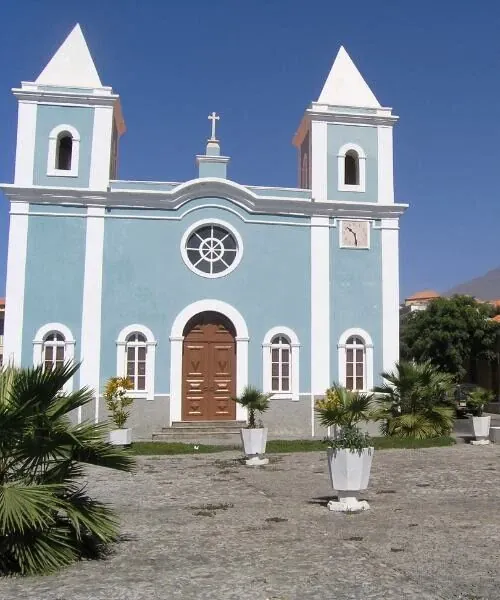
We leave the crater from the north, where grapevines and maize compete with lava flows. We reach the sea by descending through a large forest of eucalyptus, mimosas and agaves. Orange groves and coffee plantations signal the first settlements. From Mosteiros, the coastal road takes us to Sao Filipe (1 -hour transfer) for the night, a pretty colourful town with preserved colonial houses overlooking the ocean.
Vehicle transfer: between 1h and 1h30.
Night at guesthouse.

AccommodationGuesthouse
D+Elevation gain : 100 m
D-Elevation loss : 1200 m

Morning boat to Santo Antao (1 crossing time) and transfer via the coastal road to climb up the lush Paul valley to the end of the road. Small paths going from hamlet to hamlet allow us to cross like a balcony the heavily cultivated Cabo de Ribeira cirque, where coffee, oranges, guavas, vegetables and all sorts of tubers are harvested according to the seasons, and where rum is distilled. Descent through a wild valley until we reach the seaside and our accommodation.
Vehicle transfer: between 1h and 1h30
Night in a guesthouse at a small family guesthouse.

AccommodationFamily guesthouse
D+Elevation gain: 400 m
D-Elevation loss: 750 m

Short morning transfer to reach Ribeira da Torre, a deep volcanic valley surrounded by cliffs and dotted with peaks, where we spend the day discovering rural life and crops. The path and irrigation channels lead us to the farming village of Rabo Curto whose inhabitants welcome us for the meal. Descent through sugar cane and yam fields. Return in the afternoon along the coast to Vila das Pombas.
Vehicle transfer: between 1h and 2h
Night in a guesthouse.

AccommodationGuesthouse
D+Elevation gain: 450 m
D-Elevation loss: 450 m

Transfer to the coastal village of Cruzinha, through the mountainous landscapes of Ribeira Grande and Garça valleys. Hike along an impressive paved path overlooking the ocean. Picnic in the peaceful and lush Corvo valley. In the afternoon, the path passes through Fontainhas, a perched village famous for its colourful houses, before reaching for the night Ponta do Sol, the island’s former flourishing port which exudes a languorous “overseas” atmosphere.
Vehicle transfer: between 1h and 1h30

AccommodationGuesthouse
D+Elevation gain: 620 m
D-Elevation loss: 620 m

Transfer to Porto Novo via the Rope Road, a monumental paved structure crossing the mountains. There, you leave your comfortable minibus to get into pick-ups, the only vehicles capable of tackling the rough Tarrafal track.
Prepare yourself for two hours of transfer, offering a unique panorama of the island’s peak.
This is the price to pay to reach Tarrafal, a small fishing and farming village forgotten by the world, nestled in a large bay of black sand where sugar cane plantations descend to the beach. Arrival at the village on foot from a small pass and settlement for 2 nights with a local family.
Minibus transfer: between 2h30 and 3h
Night in a guesthouse.

AccommodationGuesthouse
D+Elevation gain: 10 m
D-Elevation loss: 480 m

Coastal hike under the island’s peak, a volcano of almost 2000 metres altitude that plunges into the ocean, to Monte Trigo, a fishing village cut off from the world, accessible only on foot or by boat, where no radio, mobile phone, or television signal reaches.
Return journey by boat with the fishermen (45 mins) to Tarrafal for a second night.
Please note, this boat return may be cancelled without notice in case of rough seas or if your guide judges that safety conditions are not met.
Night in a guesthouse.

AccommodationGuesthouse
D+Ascent : 350 m
D-Descent : 350 m

Morning hike through the crops of the Tarrafal valley where residents compete in ingenuity to build their terraces and irrigate their plantations.
In the afternoon, transfer (2h) return to Porto Novo, then boat to Mindelo. Night in town. Meals are independent.
Vehicle transfer: between 2h30 and 3h
Night in a guesthouse.

AccommodationGuesthouse
D+Ascent : 250 m
D-Descent : 250 m

Flight to Praia then Paris\. Arrival in Paris in the evening.
\
On certain dates, return flight via Praia or Sal and/or Lisbon.
Vehicle transfer: 30 mins

In November 2014, after 19 years of inactivity the Fogo volcano awoke and erupted. With no casualties, the lava flows nevertheless destroyed much of the highland villages of Chã das Caldeiras (Bangaera and Portela) whose thousand inhabitants were displaced. Following the halt of volcanic activity, populations are gradually returning to settle in what remains of their villages, in order to resume their activities related to agriculture (viticulture) and tourism. The volcano is accessible again and the recent volcanic activity has left spectacular traces. Sleeping in the crater however means accepting to share the simple living conditions of families who are resettling there: limited water supply, electricity dependent on a few generators or solar panels.

Please note, on certain dates flights may be via Sal and/or Praia and Lisbon. In Cape Verde, flight delays or changes are very frequent, resulting in programme modifications and adjustments. If these changes occur before departure, we will not fail to inform you, and if they occur on site, we will do our best to adjust your programme in collaboration with our local representative and your guide.

Similarly, it is possible that for meteorological or operational reasons (delays, technical problems, service modifications) boat connections between islands may be cancelled on certain days, exceptionally and at the last moment. We will adjust the programme according to these constraints.

Dates, prices and booking

Nov 29
29 Nov → 13 Dec 2026 Guaranteed
€2,950
Dec 13
13 Dec → 27 Dec 2026 Guaranteed
€2,890
Jan 9
9 Jan → 22 Jan 2027 Probable
€2,750
Jan 24
24 Jan → 7 Feb 2027 Guaranteed
€2,590
Feb 7
7 Feb → 21 Feb 2027 Guaranteed
€2,890
Feb 20
20 Feb → 5 Mar 2027 Guaranteed
€2,350
Mar 6
6 Mar → 19 Mar 2027 Guaranteed
€2,450
Mar 21
21 Mar → 4 Apr 2027 Guaranteed
€2,590
Apr 4
4 Apr → 18 Apr 2027 From 5 people
€2,590
Apr 18
18 Apr → 2 May 2027 From 5 people
€2,590
May 2
2 May → 16 May 2027 From 5 people
€2,650
May 16
16 May → 30 May 2027 From 5 people
€2,650
May 30
30 May → 16 Jun 2027 From 5 people
€2,690
Jun 13
13 Jun → 27 Jun 2027 From 5 people
€2,690
Jun 27
27 Jun → 11 Jul 2027 From 5 people
€2,690
Jul 11
11 Jul → 25 Jul 2027 From 5 people
€2,790
Oct 17
17 Oct → 31 Oct 2027 From 5 people
€2,790
Oct 31
31 Oct → 14 Nov 2027 From 5 people
€2,690
Nov 14
14 Nov → 28 Nov 2027 From 5 people
€2,590
Nov 28
28 Nov → 12 Dec 2027 From 5 people
€2,690
Dec 12
12 Dec → 26 Dec 2027 From 5 people
€2,790
Dec 26
26 Dec → 9 Jan 2028 From 5 people
€2,790
Jan 9
9 Jan → 23 Jan 2028 From 5 people
€2,590
Nov 22
22 Nov → 6 Dec 2026 Full
€2,750

This trip is primarily intended for a French-speaking group, but you're welcome to join if you're comfortable in that environment.

Details

The stated prices are valid within the limit of seats reserved on the airlines serving this destination. They are therefore subject to modification if booking occurs after all tickets have been sold. We will then propose a price supplement which you are entitled to accept or refuse.

Price includes
  • Airfare and transfers
  • Baggage transportation
  • Group leadership
  • Accommodation with full board (except certain meals)
  • Mineral water at a rate of 2.5L per person and per day during the hike (water will be provided for the group in 5L jerrycans, so you will need to have your water bottle)
Price excludes
  • Insurance
  • Registration fees
  • Visa fees
  • Tips
  • Drinks (except for the 2.5L per day for hikes)
  • Meals and drinks in Praia and Mindelo
  • Lunch on day 14 in Tarrafal

Options & supplements

  • Single room supplement (subject to availability): contact us

Your advisor

Kristiina Gaillard

Kristiina Gaillard

Travel Advisor

Write

Technical and practical information

4 to 6 hours of walking per day approximately. Positive elevation gain of 300 to 500mmeters. Good physical condition required. Altitude of 1500 to 2500mmeters.
We hike on wide paved mule tracks (a fabulous network and structures) connecting villages, and on mountain trails. The terrain is volcanic in nature, sometimes rocky, with some steep slopes.
The – optional – ascent of the 1000mmeters Pico (Fogo) is moderate level.
When we stay two nights in the accommodations, possibility of leisure time.

The vehicle that transports your baggage between stages can also transfer participants having difficulty.

The boat crossing from Fogo to Brava takes place on certain days on a fishing boat used by the government for passenger transport. Basic comfort, and the sea can sometimes be rough in the channel between the two islands. For those very sensitive to seasickness, do not hesitate to bring tablets.

Two islands are only accessible by boat: Santo Antão and Brava.

For Santo Antão, the ferry is generally on time and service is daily.

For Brava, the ferry operates 5 times per week, but due to weather or operational reasons (delays, technical problems, service changes) the service may be cancelled on certain days, exceptionally and at the last moment. In this case, a replacement boat may be chartered on location, subject to availability. Your guide will adapt the itinerary accordingly.

From 5 to 15 participants.

15 days, 14 nights, 11.5 days of walking.

Guidance

French-speaking Cape Verdean guide.

14 nights in simple hotels, guest houses or inns, in double rooms; the bathroom is sometimes shared.

For nights at Fogo’s crater, on days 5 and 6, conditions are basic. The group is split between one or two different houses depending on the season.

In November 2014, , after 19 years of inactivity, Fogo volcano awakened and erupted. Without causing casualties, the lava flows nevertheless destroyed much of the high-altitude villages of Cha das Caldeiras (Bangaera and Portela), whose thousand inhabitants were displaced.

Following the cessation of volcanic activity, populations are gradually returning to settle in what remains of their villages, in order to resume their agricultural activities (viticulture) and tourism. The volcano is accessible again and the recent volcanic activity has left spectacular traces. However, sleeping in the crater means accepting to share the basic living conditions of families resettling there: limited water supply, electricity dependent on a few generators, the group split between two or three different houses.

For nights in Praia, Fogo (crater) and Paul, the group may be split between two or three different but nearby accommodations, depending on availability.

Possibility of a single room for an additional charge: subject to availability, to be requested upon registration.

Note: Water is scarce and precious in Cape Verde, sourced from desalination in most accommodations. The energy production system is being modernized, but it can still happen, exceptionally, that on certain days, water may run short, or it may not be hot.

Food is local and varied, based on local products. Dinners are taken in accommodations or at restaurants, traditional cuisine at midday with local families or picnics prepared by your guide. For drinking water, apart from fountains, you will find mineral water in village shops.

Please let us know at registration any food allergies or special dietary requirements; we will do our best to adapt your meals.

Meeting Point / End Point

Day 1 in Paris.

Day 15 in Paris.

You will receive approximately two weeks before your departure a notice specifying the time and location of the meeting, the name and contact details of the guide as well as the address of your first accommodation.

Flights

You will travel on scheduled or chartered flights (Air Portugal/TAP, Cabo Verde Airlines, Smartlynx Airlines, Binter). Please note that connection time may be longer or shorter if the journey includes inter-island flights, and flights are often delayed and/or brought forward, requiring us to adapt the itineraries as best we can.
Please note that on certain dates flights may be via Sal and/or Praia and Lisbon. In Cape Verde, flight delays or schedule changes are very frequent, resulting in programme modifications and adjustments. If these changes occur before departure, we will certainly inform you, and if they occur on location, we will do our best to arrange your programme in collaboration with our local correspondent and your guide.
Departure from Paris with the group on the scheduled dates: we provide passengers with airport assistance services (in Paris) to facilitate check-in. Please respect the meeting time specified on your airport notice to optimise this service.
Please note that for any flight different from the group (departure from the provinces, early departure and/or delayed return), a special mobile phone number for ‘airport assistant’ will be indicated on your notice upon confirmation of your flight plan. This number allows you to contact the airport assistants on your departure day if necessary.
Reminder: for any travel purchase without air transport, domestic flights are your responsibility. We can offer you the reservation of domestic flights (with supplement); please request this. Airport/hotel transfers (or vice versa) are also your responsibility.

Security measures: New security measures have been implemented at airports: electronic devices (smartphones, tablets, phones…) must be charged and in working order for all flights going to or passing through the United States and London. Control agents must be able to switch them on. As a precaution, keep your charger handy. If your device is discharged or defective, it will be confiscated. As this measure may be extended to other airports, we advise you to charge your electronic devices before your flight regardless of your destination.

It is difficult to swim during the hikes, the sea is often rough with strong currents. The small beaches of Praia, Sao Filipe or Mindelo are more suitable for swimming.
A number of our trips lend themselves to swimming, during a stage or at the end of the day. It would be a shame not to take advantage of this. We emphasise, however, that you alone are the judge of whether swimming is appropriate; these swims are therefore undertaken at your own responsibility and at your own risk.

Member of Action for Responsible Tourism (ATR)

Since 2012, Grand Angle is a member of Action for Responsible Tourism, the reference association for more responsible tourism. We design our trips – on foot, by bike, on snow – to invite everyone to discover the world differently: with curiosity, respect and kindness.

Present on the board of directors since 2018, we are actively contributing to evolving sector practices towards greater purpose. Concretely, we ensure:

  • Transparency in our practices and pricing
  • Respect for our partners and local populations
  • Environmental preservation on each of our trips

We also share the values of the traveller’s ethical charter, which encourages everyone to adopt simple gestures to protect the places we visit and foster beautiful encounters.

Travelife Partner

Since 2025, Grand Angle has been recognized as a Travelife Partner, an international label that certifies our responsible practices in terms of environment, ethics and sustainable management, both within our company and with our partners and in the organization of our trips.

This label, the second level of a demanding international certification, attests to our concrete actions in favour of responsible tourism. We are actively pursuing our progress towards the higher level, Travelife Certified, in accordance with our sustainable development policy

Luggage You must pack all your belongings in 2 bags: 1 backpack and 1 large soft travel bag. 1 - The backpack: A hiking backpack with a capacity of approximately 35 litres, it will be useful for transporting your personal belongings during the day. It will also serve as carry-on luggage during your transfers for all your fragile items (camera…), valuables (when your accommodation does not have a safe) and any medicines. It will be in the cabin during air transport. Generally, the weight of carry-on baggage is limited to 10kg per person. 2 - The large soft travel bag: It must contain the rest of your belongings. You will find it each evening. It will be transported by porters and/or animals and/or vehicles. You will receive Terres d’Aventure labels before your departure, which will allow you to identify your luggage with your name and address, and will facilitate the grouping of bags at airport arrivals. It will be in the hold during air transport. The weight of baggage in the hold will be indicated on your convocation or ticket.

Our recommendations if you take a plane: Check in the maximum of things in your hold baggage and keep in your carry-on baggage only what is absolutely essential for your trip. Equip yourself for the plane with your hiking outfit and take your essentials (in case of a problem with the delivery of your baggage). Please note that security controls have become very strict at airports: put knives, scissors, nail files and spare batteries in your hold bag.

What are the liquid products prohibited in the cabin?

Liquids, aerosols, gels and pasty substances: mineral water, perfumes, drinks, lotions, creams, shower gels, shampoos, mascara, soups, syrups, toothpaste, liquid soaps, deodorants… unless they are stored in a transparent closed plastic bag, approximately 20 cm x 20 cm (freezer bag type) and they are packaged in bottles or tubes of 100ml maximum each. One bag can contain several tubes or bottles.

What are the exceptions allowed in the cabin?

  • Liquid medications (insulin, syrups…): you can bring them in the cabin provided you present a certificate or a prescription in your name to the security officers. There are no restrictions on solid medications (tablets and capsules).
  • Liquid baby food: there are no restrictions on these products. Remember to bring containers that close: you may be asked to taste these foods!

Picnic supplies are provided.

Clothing

  • 1 scarf, 1 sun hat or cap
  • Sweatshirts
  • T-shirts (1 for 2 or 3 days of walking). Avoid cotton, very long to dry; prefer t-shirts in technical textiles.
  • 1 thermal base layer (remarks same as above) or long-sleeved shirts
  • 1 fleece jacket
  • 1 capri trousers, cropped trousers and/or shorts
  • 1 pair of walking trousers
  • 1 comfortable pair of trousers for the evening
  • 1 Gore-tex jacket, simple and lightweight
  • 1 swimsuit
  • Underwear
  • Walking socks (1 pair for 2 to 3 days of walking). Avoid “tennis” type socks (cotton), very long to dry and high risk of blisters; prefer those made with Coolmax for example.
  • 1 pair of walking boots with good ankle support (Vibram-type sole)
  • 1 pair of sandals or relaxation shoes for the evening

The clothing list should be adapted according to the season chosen.

Equipment

  • 1 pair of high-quality sunglasses
  • 1 pair of telescopic trekking poles (recommended): facilitates ascents and descents and very useful for moving on uneven or slippery terrain
  • 1 water bottle (2, litres minimum)
  • 1 headlamp or torch
  • Spare bulbs and batteries (to take home)
  • 1 pocket knife (to put in checked baggage)
  • 1 small pouch (preferably waterproof) to keep your money
  • Toiletries: take biodegradable products preferably
  • 1 towel: there are some that dry quickly
  • Earplugs (optional)
  • Toilet paper
  • Sunscreen and lip balm
  • 1 lighter
  • Bin bags

Sleeping

All accommodations provide bedding.

Personal Medical Kit
List of personal medical kit to be validated by your doctor:
Your regular medications, pain relief medication: paracetamol preferably, anti-inflammatory tablets, anti-inflammatory ointment, anti-diarrhoea medication, antispasmodic, intestinal antiseptic, anti-nausea medication, broad-spectrum antibiotic treatment: allow 8 days of treatment, eye drops (dust, eye infection) and antibiotic cream for the eyes, treatment for colds and sore throat (lozenges), Biafine, elastic adhesive bandage (like Elastoplast, 6 cm wide), sets of adhesive plasters + disinfectant pads + Steristrip, blister cover (SOS Blisters by Spenco brand, available at sports shops, pharmacies, drugstores…), emergency blanket, effective mosquito repellent for tropical areas. A first aid kit, provided by the agency, is placed under the responsibility of your guide.


Country: Cape Verde

Valid passport, valid for 6 months after the date of return and mandatory visa for French, Belgian or Swiss nationals. For other nationalities, we are at your disposal to help you with your procedures.

Since January 1st 2019, French, Belgian and Swiss travellers no longer need a visa to visit Cape Verde. However, they must either (preferred option)
register before departure on the website www.ease.gov.cv and pay online the airport tax of 30 euros, or complete procedures and payment on arrival. For other nationalities, we are at your disposal to help you with your procedures.
CAP015 - Last updated 11/07/2019 page 5 of 8
Attention! Tourist tax applicable to any traveller over 16 years old: 2 euros per day and per person, to be paid to hoteliers.

Mandatory vaccines: Yellow fever vaccination is only mandatory for travellers coming from an infected area, which may concern travellers arriving from Senegal. It must be done at least 10 days before departure.

Recommended vaccines: As always and everywhere, it is important to be vaccinated against: diphtheria, tetanus and poliomyelitis, hepatitis A and B, whooping cough; and less systematically perhaps: typhoid and rabies. Against meningitis, during epidemic periods, tetravalent vaccine A/C/Y/W (Menveo or Nimenrix).

Malaria prevention: It is possible to go without medical prevention, except on the island of Santiago during the rainy season (from July to October) where the (low) risk can be prevented by taking Nivaquine. Protection against mosquitoes, through repellents, impregnated mosquito nets and protective clothing, during the day as well as at night, is all the more essential as it will also protect against other insects that carry other parasitic or viral diseases (in particular dengue, occurring in an endemic-epidemic pattern, or Zika virus).

Zika Virus: Transmitted by the same mosquito as dengue and chikungunya, the disease was not considered serious (fever, rash, joint pain, healing in about a week) until the appearance, during the epidemic affecting Brazil, of severe neurological complications in newborns of mothers who had been in contact with the Zika virus. The risk of microcephaly, a source of serious disabilities for the child, leads us, in agreement with recommendations just published by the High Council of Public Health, to advise pregnant women, particularly in early pregnancy, to consult their doctor to validate their travel plans.

Other risks: Access to drinking water is a recurring problem throughout the archipelago with risks of water-borne infections everywhere outside major hotel resorts.

Medical infrastructure is insufficient. In case of a serious problem, evacuation will be to Dakar or France, after contacting the assistance company.

Cape Verde: +238.

Cape Verde is two hours behind.

Cape Verde’s climate is tropical and dry, with a very short rainy season from August to September, which is also the hottest season, with temperatures around 30°C. The rest of the time, from October to July, the sky is blue, crossed by a few clouds pushed by the trade winds. The average temperature is 25°C, slightly cooler in the mountains, moderated by winds and ocean influence. The ocean temperature varies from 21°C in winter to 26°C in summer. Autumn, winter, and spring are the ideal seasons for hiking in the Cape Verde islands.

The language spoken in Cape Verde is Portuguese.

Cape Verde’s currency is the Cape Verdean escudo. 1 € = 110 CVE (28/08/2019).

It is advised to bring euros (or dollars) in cash or traveller’s cheques. Exchange can be carried out in all banks, airport offices, and at the reception of many hotels. Bank cards are very rarely usable. If you have an international Visa card, you will be able to withdraw money from ATMs on all the islands.

This practice is rooted in tradition and is done as part of an exchange in gratitude for work provided. At the end of a trip, it is customary to show your satisfaction by giving tips to the people and guide who accompanied you. We recommend respecting the country’s standard of living as well as the length of your stay. This is of course to be evaluated based on the satisfaction provided. In no case are these indications obligatory, it is not a due and is never a salary. Plan approximately 20€ per participant.

We strongly advise against giving gifts to local residents, such as sweets, pens, etc. Cape Verdeans are naturally welcoming and this type of behavior disrupts relationships and creates undesirable effects. It is strictly prohibited with children. However, if you wish to bring school supplies or leave clothing or other items when you return, you can entrust them to your guide. The local agency on site collects the materials and distributes them to schools in the most needy areas.

Traveler’s Advice

  • To make the most of your stay in Cape Verde, you must first understand the conditions of travel on the ground. Small logistical issues (transport, supplies) may arise and will require patience, good humor, and a genuine open-mindedness to adapt to Cape Verdean realities.
  • Solar radiation is very strong in Cape Verde; you may not always notice it because the wind and ocean moderate the temperatures. You must therefore protect yourself effectively from the sun, bring appropriate clothing, a hat, sunglasses, and sunscreen. It is also necessary to drink plenty of water.
  • Petty crime exists in Cape Verde, as everywhere else. To avoid street theft and robbery, be minimally vigilant in town when you walk around with a camera, mobile phone, handbag, etc. On the other hand, it is wise to leave your passport, money, and valuables at your hotel. Your guide will give you useful advice on this point.
  • Celebrations and nightlife: Music, dance, and folk song are central parts of Cape Verde’s vibrant culture. Various venues offer musical evenings in the early evening, although this is not systematic. Most celebrations tend to take place later into the night, often after midnight.

Reviews

This trip doesn't have reviews yet. Discover what travelers say about similar trips.

★ ★ ★ ★ ★    Comment sent by Anne in December

A very comprehensive trip to discover the island's main sites, despite capricious weather in mid-November.

★ ★ ★ ★ ★    Comment sent by Jean Luc in February

A 12-day trip allows for real immersion: the desert, the staff who accompany you, the weather, the type of accommodation, the meals, the guide's comments (biology, geology, tradition, botany, economy, history...).

★ ★ ★ ★ ★    Comment sent by Françoise in June

A Sublime Journey

★ ★ ★ ★ ★    Comment sent by Olivier in June

My wife and I are very happy with this trip. Everything was "top-notch": the guide, the local team, the weather, the group atmosphere, and the scenery. It would be hard to do better!

Would you like to make this a private trip?

Travel with friends or family on dates that suit you. Tell our specialists what you have in mind.

We also recommend

Continue exploring

Guided tours Self-guided Cycling Tailor-made
Dolomites Mont Blanc Danube by bike Madeira All destinations
Guided tours Self-guided Cycling
Tailor-made travel Trip insurance Contact
About us