
Welcome at the airport and transfer to the hotel.
Overnight in Mindelo (or Praia), dinner at your own expense.
AccommodationHotel
Choose which cookies you accept. Privacy policy
Audience measurement
Google Analytics and Matomo cookies — journeys, searches and bookings.
Targeted advertising
Google Ads, Meta and Effinity — conversions, personalised ads and campaign attribution.
Travel assistant
AI-generated answers. Check important information on our information pages, in your contract or with a human advisor at GrandAngle.Travel.
AI answers — when in doubt, ask an advisor.




Off the coast of Africa and west of Senegal, this trip invites you to explore the islands of Cape Verde on a self-guided hiking holiday.
The Cape Verde islands form a bridge between Brazil, Africa and Portugal: islands with breathtaking landscapes and warm encounters with local people.
Alongside the spectacular scenery of peaks and lush valleys, arid slopes and sometimes active volcanoes, you will find the warm hospitality of Cape Verdeans and their music, both joyful and melancholy, blending Portuguese fado with Brazilian rhythms.
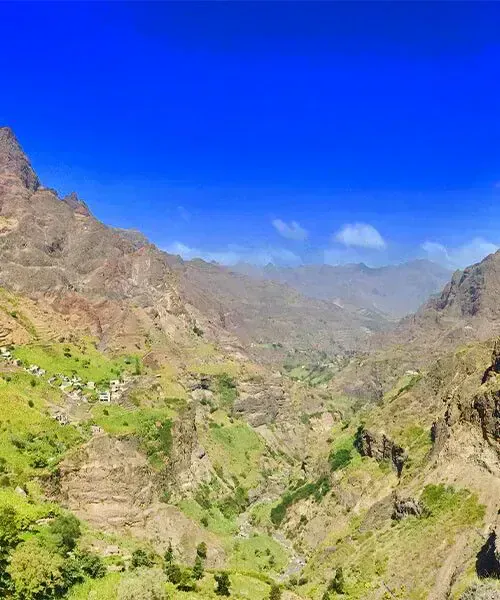
The island of Santo Antão unfolds into deep valleys with lush tropical terraces, while its desert foothills rise into imposing basalt walls. Hamlets filled with lilting music dot our hiking routes.
The island of São Vicente is a desert reaching out into the ocean, sheltering beautiful Mindelo, a small colonial town and Cape Verde’s cultural capital.

Welcome at the airport and transfer to the hotel.
Overnight in Mindelo (or Praia), dinner at your own expense.
If you arrived in Praia, take a domestic flight to São Vicente island. If you are already in Mindelo, enjoy free time to explore this small colonial town nestled in a bay.
In the afternoon, travel across the island by vehicle through the central oasis. Hike through the solidified lava formations along the Praia Grande coast. Overnight in Mindelo, dinner at your own expense.
Overnight in Mindelo.
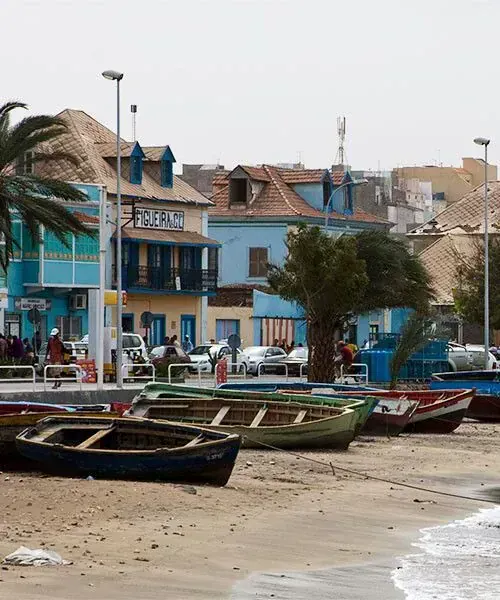
Take a boat to Santo Antão. Transfer along the coastal road and walk in the Penede valley at the eastern tip of the island. The foothills of Pico da Cruz plunge into the ocean, offering beautiful views of sea and mountains, while sugar cane fields stretch down to the water’s edge. Continue to Vila das Pombas, in the Paul valley, for the night.
Dinner and overnight in Vila das Pombas.
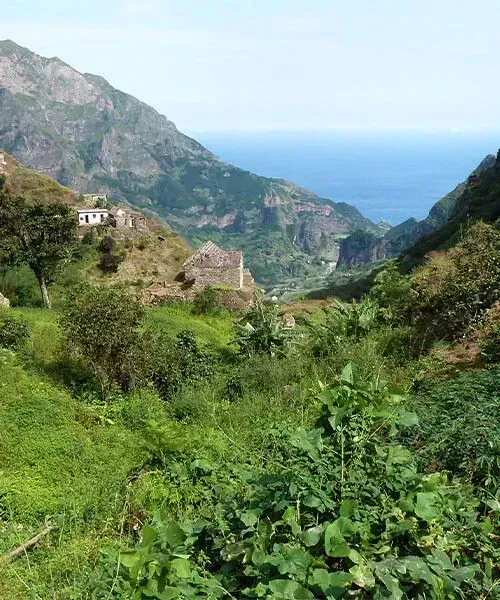
A short transfer followed by a hike in the Paul valley, said to be the greenest in the archipelago, to discover rural life. Plantations of bananas, coffee, oranges, guavas and sugar cane line the walk, creating an ever-changing landscape. As you cross a ridge, the views stretch from the high ridges to the sea. Descend to the lower valley for a second night in Vila das Pombas.
Overnight in Vila das Pombas.
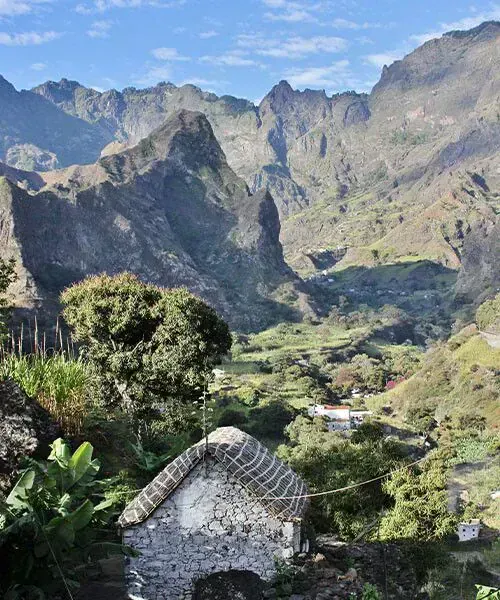
Short morning transfer to Lombo Branco. A point-to-point hike through the valleys of Lombo Branco, Monte Joana and Pinhao, where terraced fields, cypress trees and thatched cottages punctuate a day of alternating short ascents and descents. Continue to Ponta do Sol, a small fishing port, and settle in for two nights.
Overnight in Ponta do Sol.
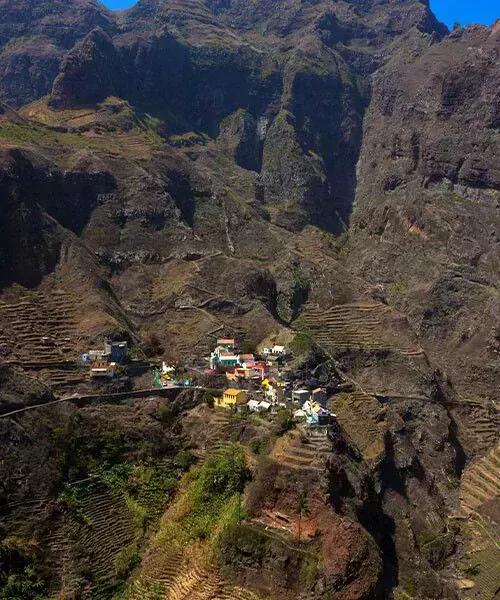
Following a paved track, you travel by vehicle up the Ribeira Grande valley, then down the Garça valley. From Cruzinha, you take the coastal path, perched between a volcanic cliff and the Atlantic. The path crosses the extensively cultivated Corvo valley and the colourful village of Fontainhas before reaching Ponta do Sol.
Overnight in Ponta do Sol.
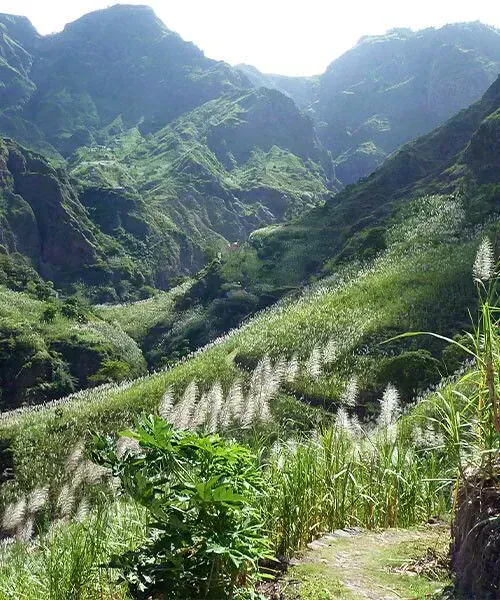
A short final day’s walk in the Ribeira da Torre valley, around an imposing volcanic peak rising from the middle of the valley, surrounded by sugar cane fields and banana plantations, with jagged ridges all around. Continue along the Corda road to discover this remarkable feat of engineering and the Cova crater, then take a boat to Mindelo in the late afternoon. Stay overnight in the town centre.
Overnight in Mindelo, dinner at your own expense.
Transfer to the airport and return flight (or extend your stay; please contact us).
We may need to change the itinerary shown for logistical reasons (accommodation capacity issues, changes in terrain conditions, landslides, damaged paths, etc.). These changes are always made in your best interests, for your safety and greater comfort!
Depart on a date of your choice, all year round.
Indicative price per person for a stay of 8 days and 7 nights, depending on group size.
2025 - 2026
| 2 people | 3 people | 4/5 people | 6/7 people | 8 people or more |
|---|---|---|---|---|
| 965 € | 850 € | 805 € | 755 € | 720 € |
2026 - 2027
| 2 people | 3 people | 4/5 people | 6/7 people | 8 people or more |
|---|---|---|---|---|
| 980 € | 865 € | 815 € | 765 € | 730 € |
Flight schedules and late arrivals in Praia or Mindelo often mean that an extra night with transfers needs to be added: 70 €/person.
Kristiina Gaillard
Travel Advisor
Level 3/5
Daily stages involve 3½ to 5½ hours of walking, with 450 to 500 metres of ascent.
You only need to carry a daypack with your belongings for the day. Your luggage is transported by vehicle.
Transfers in Praia, São Vicente and Santo Antão are by private taxi or minibus with a French-speaking driver. The crossing between São Vicente and Santo Antão is on a scheduled ferry service.
From 2 people.
8 days / 7 nights.
This is a self-guided trip. Joining instructions are sent by email before departure; a travel pack containing a map, route notes, vouchers and ferry tickets is provided on arrival.
Rooms for 2 with en-suite shower facilities in simple hotels of approximately 2* standard.
An accommodation upgrade is available in Mindelo (2 nights): a lodge in the hills above the town with a stunning view of the bay. Rooms have private terraces; there is a swimming pool and a rooftop terrace for breakfast.
In Mindelo and Praia: breakfast only.
From Day 3: full board, with breakfast, picnic lunches and evening meals.
Water: drinking tap water is not recommended. Bottled mineral water is available.
On Day 1 at Mindelo or Praia airport.
On the evening of Day 8 at Mindelo airport.
A number of our trips offer opportunities to swim during a day’s walk or at the end of the day. It would be a shame to miss out. However, we emphasise that you alone must decide whether it is appropriate to swim; any swimming is therefore your own responsibility and undertaken at your own risk.
Since 2012, Grand Angle has been a member of ATR, the leading association for more responsible tourism. We design our trips – on foot, by bike and on snow – to encourage everyone to discover the world differently: with curiosity, respect and kindness.
As a member of the board of directors since 2018, we actively help the industry develop more meaningful practices. In practical terms, we are committed to:
We also share the values of the Traveller’s Ethical Charter, which encourages everyone to take simple steps to protect the places they visit and create opportunities for meaningful encounters.
Since 2025, Grand Angle has been recognised as a Travelife Partner, an international label that certifies our responsible practices in environmental protection, ethics and sustainable management, both within our company and in our work with partners and the organisation of our trips.
This label, the second level of a rigorous international certification scheme, recognises our practical actions to support responsible tourism. We are actively working towards the next level, Travelife Certified, in line with our sustainable development policy
For hiking
Note: synthetic technical clothing performs very well. Merino wool clothing is also available; it performs very well, is comfortable to wear and has the advantage of resisting sweat odours! (Brands include Icebreaker, Ruka, etc.).
As a general rule, avoid cotton, which makes you cold when wet.
For your lunchtime picnic
For protection from sun and rain
After your hike
Adapt this list to the season. The Grand Angle team is here to help your trip run smoothly, so please feel free to contact us: we will do everything we can to make your stay a success.
Country: Cape Verde
Capital: Praia
Population: 544081 inhabitants
French nationals need a passport valid for at least 6 months after their return date
The requirement for French nationals to obtain an entry visa in advance was abolished from 1 January 2019. French nationals travelling to Cape Verde for tourism are exempt from visa requirements if their stay does not exceed 30 days.
Regardless of the length or purpose of their stay, all travellers who are neither Cape Verdean nationals nor holders of a Cape Verde residence card must pre-register on the dedicated government platform www.ease.gov.cv at least five days before arriving in Cape Verde. Their tour operator or travel agency can also complete this process on their behalf. During pre-registration, travellers enter their passport details, expected arrival and departure dates, flight number and accommodation details, and pay an airport security tax of 3400 escudos (30,83 euros). Travellers are advised to keep proof of payment of this tax so they can present it on request upon arrival in Cape Verde.
No vaccinations are compulsory, except in the event of an endemic disease outbreak. All travellers going from Cape Verde to Senegal must be vaccinated against yellow fever. Vaccination against hepatitis A and B is recommended. Drinking tap water is not recommended; plan to buy mineral water locally.
French Embassy in Praia
28 Tenente Valadium – Plateau district
CP192 - Praia
Telephone: 002382604535
Cape Verde +351.
There is a time difference of two hours in winter and 3 hours in summer.
Throughout the year, the sun provides steady warmth, tempered by the cool sea breeze. There are two seasons: a dry season from November to July and a wet season, with some rainfall, from August to October. The climate is dry tropical, with low humidity and an average annual temperature of around 25°C. The temperature range never exceeds 10°C thanks to the influence of the ocean, and sea temperatures range from 21°C in February and March to 26°C between July and October.
Official language: Portuguese; national language: Creole.
Cape Verdean escudo (CVE, sometimes abbreviated as $CV or $).
1 € = approximately 110,27 CVE
100 CVE = approximately 0,91 €
Currency exchange services are available at banks (open from 8 to 2 pm, Monday to Friday) and some hotels.
The currency cannot be exchanged outside the country, but you should have no difficulty exchanging any remaining local currency before you leave.
Cape Verdean traditions
Music
Music is undoubtedly Cape Verde’s greatest treasure. Singing is second nature to Cape Verdeans. The best-known songs (those performed by Cesaria Evora, Bana or Tito Paris) are mornas, wistful ballads expressing saudade, the longing that connects Portuguese-speaking peoples. They are reminiscent of Portuguese fado or Argentine tango.
The coladeira is similar to the morna, but has a livelier rhythm, closer to Brazilian music. The batuque and finaçon are the archipelago’s most distinctly African musical styles, originating on the island of Santiago. They feature women’s choirs using cloth wraps enclosed in plastic and held between their thighs as percussion instruments. In finaçon, the lyrics are improvised. Nacia Gomi is its foremost exponent. The funana, also from Santiago, is music of protest, banned under Portuguese occupation and very popular among young people today. The funana is distinguished by the use of a small accordion (the gaïta) and a piece of iron (the ferrinho). Ferro Gaita is the most popular band.
Other musical styles include tabanka (parade music) and batucadeira (carnival music).
Cape Verdean musicians to discover include Bau, a virtuoso on string instruments (guitar, violin and cavaquinho), Luis Morais, and, among more contemporary performers, Simentera, Boy Gé Mendes, Projecto Ayan, Cordas do Sol and Mayra Curado Andrade, Cape Verde’s new golden voice.
Painting
Cape Verde’s greatest painters were born or live in Mindelo, a city designated the cultural capital of the Portuguese-speaking world. The best known are Tchalé and Manuel Figueira. Their waterfront studio, opposite the Belém Tower, has become an institution, but is increasingly difficult to visit because the artists are rarely there. Alongside Bela Duarte, Luisa Queiros, Leão Lopes and others such as Joãn Fortes, these visual artists each develop their own style, sharing a profusion of colour and a tendency towards figurative art.
Their works can be seen in cultural centres and at Café Lisboa in Mindelo. Murals and sculptures by Ro and Nild can also be found in various parts of the city; these two artists have their studio in the Bela Vista neighbourhood.
Crafts
Local crafts remain fairly limited, but are gradually developing. They mainly consist of batik (hand-dyed textiles), ceramics, stone or coconut carvings, and shell jewellery.
Mindelo is home to a National Crafts Centre, and a few talented craftspeople have settled in Santa Maria. However, most of the crafts found on the islands, including wooden figurines, masks and necklaces, come from the African coast and are sold by Guinean and Senegalese traders.
Source: www.routard.com.
4,3 · 6 reviews
Marie-France 7/29/26
— Very warm welcome; the hikes were a bit challenging but enjoyable and offered a nice change of scenery
Xavier 6/23/26
— We are delighted with this experience. Magnificent, varied routes that are easy to follow. The transfers were perfectly coordinated, the drivers warm and careful. Grand Angle and its local partner were easy to reach and were very responsive to the few adjustment requests we made to them. The accommodation was simple and perfectly adequate. In short, a wonderful trip without the slightest hitch.
—
— Reply from the team
Would you like to make this a private trip?
Travel with friends or family on dates that suit you. Tell our specialists what you have in mind.

Currently unavailable
4,5 · 2 reviews

From €1,590
4 · 1 review

From €2,350

Currently unavailable
5 · 1 review

3 trips

81 trips

77 trips

77 trips

47 trips

43 trips

41 trips

38 trips

34 trips

34 trips

33 trips

33 trips

32 trips

32 trips

31 trips

28 trips
25 trips

23 trips
Call us